By Laura Jackson Roberts
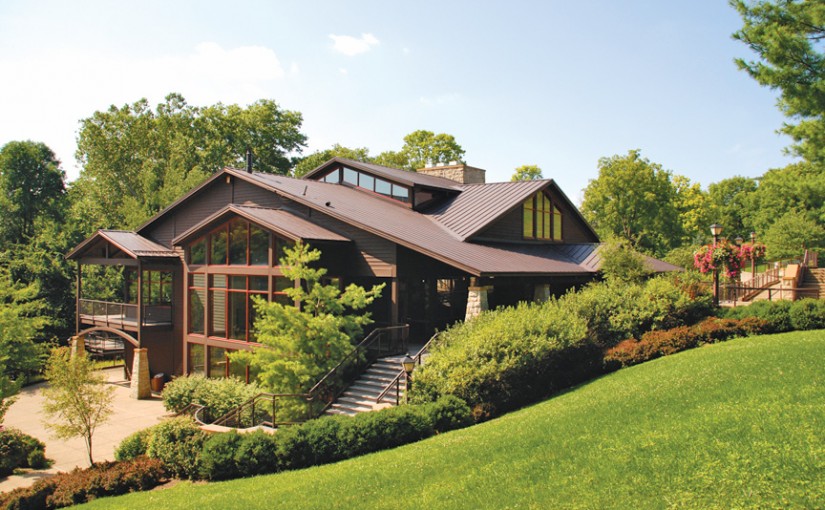
Oglebay Institute’s Schrader Environmental Education Center offers a wide variety of programs for the community. My kids attend camp. I’ve gone fungi-hunting and owl-calling. My husband and I constructed rain barrels and compost bins on our anniversary, and my son and I went in search of salamanders last spring. There’s always something to do up there.
By comparison, a lecture series may not sound as flashy. Possibly, the word “lecture” conjures a memory of your college days in a stuffy hall with a droning professor. I get it. But my father used to tell me that the older he got, the more he realized how much he didn’t know. And he’s right: There is so much I don’t know about this world of ours, and so much I want to learn now that I’ve lived in it for almost four decades.
This is why lectures, especially the kind you can attend at the Schrader Center, are so valuable. And so interesting.
Impact of Changing Bird Populations
On Sunday, February 25, Dr. Jay Buckelew will be speaking. He spent 42 years teaching biology at Bethany College, and his personal passion is birds. He’ll be talking about bird populations and the impact our changing environment has had on them. Then, on Sunday, March 25, Mary Ellen Cassidy will be speaking. I caught up to her to ask her about her upcoming lecture.
Renewable Energy
Mary Ellen has been educating people as long as I’ve known her. She taught chemistry at Linsly when I was a student there and went on to teach at Wheeling Jesuit University and the Schrader Center. She now serves as Coordinator for the New Energy Economy Program at the Wheeling Academy of Law and Science (WALS). She’s on the City of Wheeling’s Ad-Hoc Committee on Recycling, is a Board Member of WV SUN, and Coordinator of the Wheeling Solar Co-op.
Mary Ellen will be presenting on matters of renewable energy. Solar is her specialty, but she’s a proponent of sustainability and living green in Wheeling. She’s excited to share what she’s learned about sustainable living with our community, and she says that the Schrader Center is the ideal venue for this kind of series.
“I just love anything where you can go and learn about something you’re truly interested in,” she said, “or something that you don’t know much about, and you go up and stay for an hour and all of a sudden this becomes one of your primary interests. I love that a city like Wheeling can have these opportunities.”
Join the Conversation
It’s not really a one-sided lecture so much as a conversation she’s hoping to lead.
“It’s a wonderful place to have a conversation in general because the audience really is there to learn and to share information with you. They come with the intent that, ‘How can we make this better, or, ‘How can we make this work?’ So it’s a wonderful place to be able to present and share ideas. The audience is also usually very well educated in many things, so what I like about it is, not only can I share what I know, but I can kind of hear from them and then add that in. They’re a great audience.”
When I asked her about the age range of program participants, she told me that she most often sees an older audience. They’re very well-read, eager, and come with hands-on ideas. I was surprised to hear that younger generations aren’t in attendance as often. Locally, young people have helped to grow our art community in both visual art and music. Similarly, local food has become an important issue to millennials. Mary Ellen is hopeful that they’ll soon join the sustainability-in-Wheeling conversation, too.
The Future of the City Belongs to the Young People
“I would love to see them be involved with how we can figure out the energy systems that would be best for our city,” she said. “The future of the city belongs to the younger generation and I would love to see more young people involved no matter what their job is or their affiliations are. I would love to hear from more young voices.”
Organic Squash-Growing is Great, But Let’s Work On Sustainability
Later, I thought about this hesitancy. When we spoke, Mary Ellen told me that, in her experience, people tend to make an immediate decision when you say you want to talk about the environment. This is going to be unpleasant, they think. Thirty years of conditioning have taught us that the news is always bad and that we are to blame. We expect to sit in a lecture hall and take a beating. No wonder we’d rather brew a craft beer and grow an organic squash. And if you think about it, our organic squash-growing efforts have an immediate result: we get a squash and it’s delicious. Working on sustainability is a little tougher because there’s no immediate payout. And so that distance, in our minds, removes the problem’s urgency.
Let’s Talk About Solutions
Mary Ellen acknowledges that it can be overwhelming. The lecture series’ goal, therefore, is not to harp on problems but to introduce answers. She wants to talk about what we can do right now. For example, she and her husband, attorney Patrick Cassidy, own the First State Capitol building on Eoff Street. The building was built in 1858 and served as the first official capitol building for the state of West Virginia. In 2015, the Cassidys made energy-efficient improvements that included fitting the roof with American-made solar panels. This is an example of a solution, an active step we can take towards reducing our carbon footprint.
She wants to continue that conversation at the Schrader Center, not only to talk about the benefits of solar, but to present alternatives to solar as well because it isn’t for everyone. In fact, I looked into solar a few years ago, but the height and density of the trees above my house rule me out as a candidate. I’d like to know what else I can do to make my time on this planet a bit more sustainable. And Mary Ellen isn’t going to make me sign a contract when I arrive at the lecture. She just wants to talk.
“It sounds so overwhelming,” she said. “But I think the communication has to be about energy efficiency, renewables, what they are already doing. I think that’s where we need to head.”
Whether you’re ready to take the next step or just want to talk, consider a trip to the Schrader Center to be a part of this important conversation.
Living Green Schedule
Join Dr. Jay Buckelew on Sunday, February 25 for a conversation about bird populations. Mary Ellen Cassidy will be presenting on solar energy and sustainability on March 25. On April 29, Dr. Zachary Loughman will discuss new wildlife species of the Appalachian Mountains. All programs take place at 2pm at the Schrader Environmental Education Center.