Blog

#OpenOnPenn: Art Exhibit Stirs Emotions

By Laura Jackson Roberts

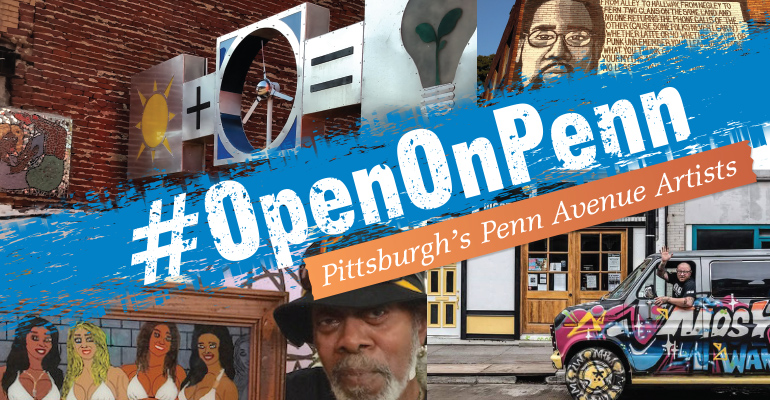
What is art? That was the question I was supposed to be asking myself as I walked around the opening of #OpenOnPenn, the current exhibit on display at Oglebay Institute’s Stifel Fine Art Gallery.

My friend Christina and I wandered the space. All of the pieces had a modern feel, and the mediums ranged from paint to metal sculpture to….well, what exactly was I looking at? Beat up, crunched-down, spray-painted demolition cars. A panel of what appeared to be circuitry. A sheet of plastic blowing in the wind of an oscillating fan. I’ve been to many openings at the Stifel Fine Arts Center. I’ve seen photography, student art shows, and pottery. This, however, felt distinctly different.

OI Collaborates with Pittsburgh’s Most Want Fine Art Gallery

#OpenOnPenn is the result of a collaborative effort between Oglebay Institute and Jason and Nina Sauer of Pittsburgh. They own the Most Wanted Fine Art Gallery (on Penn Avenue, naturally) and served as the judges for the 2017 Regional Student Art Exhibition. Just as Wheeling celebrates arts and culture on the first Friday of each month, Jason and Nina are a part of Pittsburgh’s much larger monthly event.

Art Cars, Graffiti & Social Justice Issues

Jason created the focal point of the show: the “art cars.” Andy Warhol painted the most famous and valuable of these. But Jason doesn’t just paint the cars. He drives them too. His favorite pastime is demolition derby racing. Many of the artists on display have similar non-traditional backgrounds; some have no formal art training. This show has an urban, street-art feel, with elements of graffiti and intense graphics as well as a not-so-subtle nod to social justice issues.

Nothing about it will feel commonplace or ordinary. In fact, when you visit, you’ll realize how lacking in this type of exhibit Wheeling has been.

As we walked about the gallery, my friend Christina became obsessed with a particular painting. She’d disappear and I’d find her staring at it, mesmerized. We talked about it. We dissected it. We worked on some theories and asked questions. She spoke to the artist himself who explained just enough of the painting to stir up far more questions than he answered. By the end of the evening, she’d tied herself into mental knots.

I’m Feeling Uncomfortable.  Is that Ok?

It happened to me, too, when I came across a piece that took me aback. While some of the other work fascinated me, delighted me, or even confused me, this particular piece made me uncomfortable. I tried to pinpoint what about it bothered me. Was it the medium? The composition? I tried to break down my feelings and ask myself: What exactly do you dislike about the piece? Is there anything about it that you do like? What emotions are you feeling when you see it? What does this piece represent for you? Waves of discomfort washed over me as I considered these questions.

And then I felt guilty. I stood in this sacred space, amidst several of the artists themselves, creatives who no doubt worked their tails off and put their hearts and souls into these pieces. They came to Wheeling to share their work with our fine people and here I was, feeling, quite frankly, kind of icky about this piece in front of me. Was I allowed to be creeped out? Was that wrong? Was the artist standing nearby watching me watch crinkle my nose at their blood, sweat, and tears?

Stirring Emotion Through Art

I thought about my own medium. When I write, I want my words to make you feel something. It’s the writer’s job to stir some sort of emotion within the reader. Sometimes I try to control what you feel, to make you laugh or stir up sorrow. That’s a tightly crafted endeavor on my part. Other times, however, I’m writing for me, not for you. I’m writing about how I feel, and your reaction is solely yours. You may like what I’ve created; you may hate it. But as long as you feel something, I’ve done my job.

Did that artist want me to feel a certain emotion when I looked at that piece? Or did they make it as an expression of their own consciousness? I can’t know that. And I don’t think that’s the point of the piece. Rather than dissecting the art or the artist, I found myself dissecting me.

Quite frankly, it was exhausting. I got a lot more than I bargained for. That piece stuck with me. It continues to haunt me several weeks later. I’ve gone back to the exhibit to see it again, and each time I’m left thinking more about me than about the art on the wall. Well done, brave artist. Well done.

A photographer and friend of mine once told me that good art doesn’t give you the answer. It gives you the question. I hated the quote at the time because it felt like a way to explain art without truly explaining art and because I wanted that resolution.

But now I get it. The artist will ask questions. How we answer them belongs to us.

Go & See

#OpenOnPenn will be on display at the Oglebay Institute Fine Arts Center through October 27. See it free of charge Monday -Friday, 9am-5 pm., Saturdays 10am-4pm. Evening hours are dependent on classes & special events.  For more information call (304) 242-7700.
Schrader Center Programs Engage Nature Lovers

by Laura Jackson Roberts

If you stand outside at night and hold a flashlight against your nose with the beam pointing down at the grass, you’ll see green flashes here and there. The illumination will remind you, somehow, of your cat’s eyes in the dark, hollow and vacant and other-worldly. These green lights are indeed eyes staring back at you: spider eyes. If you’re completely creeped out, you can skip this paragraph. But if you do see the little green lights, follow them. Inspect their source and you’ll find a spider. Yes, some will be big, but rest assured that most will be tiny.

Take a Hike:  Full Moon Walk at Bear Rock Lakes

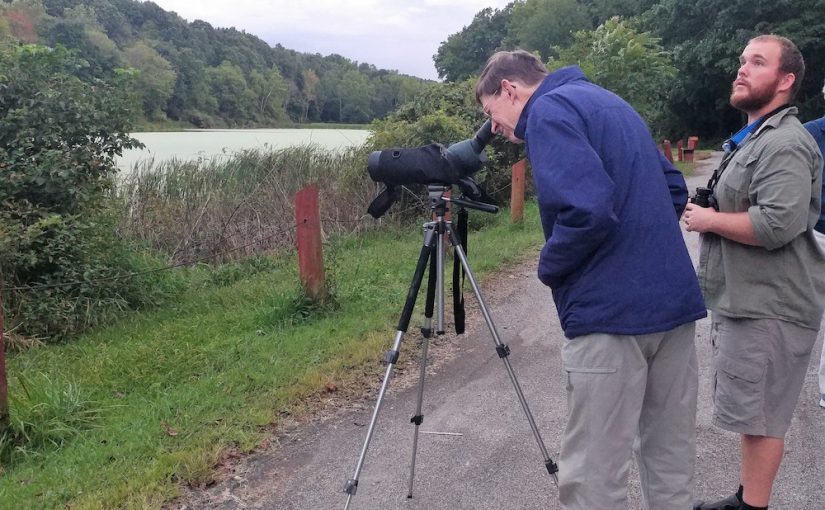
I learned this trick from Mike Hensley, a naturalist at Oglebay Institute’s Schrader Environmental Education Center. The Schrader Center has recently expanded their class offerings to include more adult nature programs. One evening in September, I met up with Mike and several other folks under a full moon at Bear Rock Lakes, beyond Dallas Pike.

In the past, I’ve attended family nature classes and events specifically for kids and toddlers. This time, though, I ditched the rugrats, and in so doing, I got to enjoy aspects of a full moon nature walk I normally miss when I’m mitigating fisticuffs and tying shoes. In fact, when I pulled up, I found Mike and the others gazing through a spotting scope at a flock of green-winged teals in the headwaters of the lake. North America’s smallest dabbling duck (a duck that floats and turns bum-up in the air, as opposed to a duck that dives completely underwater) probably wouldn’t have held my kids’ interest, but I was thrilled to get a chance to study them.

Mike explained that we’d be taking a guided hike through the woods, listening for animals, calling birds, and conducting a few sensory experiments. To my joy, the goal was quiet and peaceful nature.

Owls, Bats, Frogs and Fireflies!

We began with owl-calling in the forest, specifically screech and barred owls. Some nights Mike has been successful enough that an owl swooped in, but this evening they were stubborn and silent. Instead we heard a soothing chorus of katydids and crickets—not bad at all—and I asked Mike to identify each nighttime noise as I heard it.

As we walked along, Mike talked with us about using our sense of touch, the importance of which he demonstrated by having us reach into a bag to identify various seeds and leaves. From there we moved on to identifying frogs; despite the late season we heard a spring peeper and saw a few froggy eyes in the pond staring back at us. A little brown bat fluttered by, which sparked a bat lesson, and once we were all looking up, the conversation moved to stars and visible planets. Mike assembled the spotting scope again so we could view them. As we waited for the moon to rise, I found a glow-worm, the larval stage of a firefly. Mike identified the call of an American toad.

Everyone Needs a Naturalist

It was an evening during which we studied a little of everything we encountered and I thought to myself that everyone should have a naturalist on stand-by at all times. They’re very useful people.

A walk in the woods with a naturalist is a lot like bringing a set of encyclopedias with you. Encyclopedias, however, can’t engender a sense of wonder about the place you call home, a setting that tends to feel rather bland and ordinary. And they can’t teach you how to find spider eyeballs in the dark.

I had a good time on the moon walk, so a few weeks later I attended a second adult class: Fungus Among Us. While I’m not a mushroom collector and have only in my late 30s embraced them on pizza, I do find their study—and the people who dig them up—endlessly entertaining. We’ve always got strange specimens popping up in the backyard, but mushroom identification is a tricky pastime. Molly Check, the director at the Schrader Center, led this particular class.

I talked with Molly about the new adult programs.

“Each of our adult nature programs is unique, but they all provide opportunities to learn more about the natural world,” she said. “At the Schrader Center, we hope to inspire lifelong learners, from acorn to oak. No matter what your age, we have programs for you to enjoy. Nature provides many lessons for adults, from re-learning how to be still in the forest and listen to birdsong, to noticing unique features of a particular animal you may see in your neighborhood. The Schrader Center staff are knowledgeable and enthusiastic educators, ready to teach adults about wild edible plants, migrating birds, mammals, insects, gardening, sustainable living, tree ID, and so much more.”

Fungus Among Us

We started with a little classroom time. I was pleased to recall quite a bit of high school biology, but what I didn’t know was how to identify a mushroom. Molly taught us about life cycles and about categories including shelf fungus (the ones you see on tree trunks), cup fungus (which look like tiny champagne glasses), and puffballs (everybody’s favorite). We talked about where and when to find them (it turns out that fall is prime mushroom season), and then someone brought out a bag of lovely orange specimens and we all gathered around to sniff them and guess at their species.

Mushroom Hunting

The world of fungus boasts over 87,000 identified species, 1,700 of which are in West Virginia, so identification often requires more than just a picture in a book. Real fungus folk rely on microscopes and spore prints to correctly pinpoint what they’re looking at. And it’s important to do so, Molly said, when the conversation turned to poisonings. (Mushroom deaths seem to horrify and fascinate us in equal parts.)

“Most mushroom are not edible,” she reminded us. Granted, most toxic mushrooms aren’t fatal, but an identification mistake can certainly make you violently ill.

With our newfound knowledge, we wandered out into the butterfly garden and down into the woods behind the Schrader Center. Just like Mike, Molly seemed to know something about everything—bird calls and seed pods and butterflies. We brought her a variety of fungi: mostly shelf fungus known as Turkey Tail, but also Crowded Parchment, some tiny cup fungi, and a blog of orange jelly that, apparently, can move on its own as an animal would. Alas, when I brought Molly a stick, she told me I’d only found dry rot. Still, I now have mushrooming skills.

Maybe I’ll put them to use on one of my own hikes.

Go, See & Do!

If you’d like to check out one of the Schrader Center’s adult programs, you’ve got some great choices. Upcoming adult programs include Fall Birding (10/21 & 11/18), Full Moon Walks (1/31 & 3/1), Predators in Your Backyard (11/14), Trivia Pursuit (1/10), and Skulls (2/7).  The Living Green Lecture Series will feature local presenters speaking on a variety of environmental topics on the last Sunday of each month from 2-3pm beginning in January.

Schrader Center

Find out more at www.oionline.com or by calling the Schrader Center at 304-242-6855.  Check out the online class schedule and visit the online calendar of events.