By Phyllis Sigal
“All My Sons’ was the best production I’ve ever seen at Towngate!”
“… an amazing performance! So moving. Brought tears to my eyes.”
“I saw the show twice and was thusly gobsmacked twice.”
“Rachel Thompson is a wonder, and I don’t have words enough to say how much I admire her ferocity as Kate Keller.”
“To see or not to see? Answer: To see …”
“Tim Thompson, Rachel Thompson, John E. Reilly, and the rest of the remarkable cast were unerringly directed by Dennis Fox into giving a most memorable performance, made even more haunting by Dave Henderson’s evocative set.”
“Rachel and Tim Thompson … wow. Just wow.”
Can Towngate Theatre’s upcoming season live up to the rave reviews from last season’s performance of “All My Sons”?
CURTAINS UP!
Oglebay Institute director of performing arts Tim Thompson (who received many of the above accolades), is looking forward to a rousing new season of well-chosen plays and a slate of experienced directors.
“Our season is similar to last year in play choices … except for one,” he noted. “We are doing a musical again … opening with ‘Into the Woods.’ Bringing back musicals to Towngate has been very successful. Audiences love a musical, and ‘Into the woods’ is Stephen Sondheim. The best.”
Towngate will stage a new drama and an older comedy.
“Our comedy, ‘Biloxi Blues’ (1984) by Neil Simon is a familiar play by a very well-known playwright.” It also was a successful movie starring Mathew Broderick, Tim pointed out.
“Our drama is a newer play (2006), ‘Rabbit Hole’ by David Lindsay-Abaire.” It deals with a young couple’s loss of a child and how to move forward with their lives, Thompson explained.
A new offering this year is Shakespeare. “For the first time since 1976, Towngate will produce a Shakespeare play, ‘Twelfth Night,’” Thompson shared.
A CAST OF DIRECTORS AT TOWNGATE
This year, audiences will experience the work of several directors: Dave Henderson, Towngate’s artistic director, “Into the Woods”; Towngate’s technical director, P.D. Gregg, “Biloxi Blues”; veteran actor Butch Maxwell, “Rabbit Hole.” And Dennis Fox, who called the shots for “All My Sons” last season, will direct “Twelfth Night.”
“Coming off a very successful Towngate directing debut with ‘All My Sons,’ I am very happy and excited to be directing this season’s final production, Shakespeare’s ‘Twelfth Night,’” Fox said. “Considered by many to be his greatest comedy, ‘Twelfth Night’ marks the first return of Shakespeare to the Towngate stage in 46 years. ‘Twelfth Night’ is a masterpiece of romance, comedy, and music, and I am extremely honored and grateful to be able to help bring it to the Towngate stage,” he added.
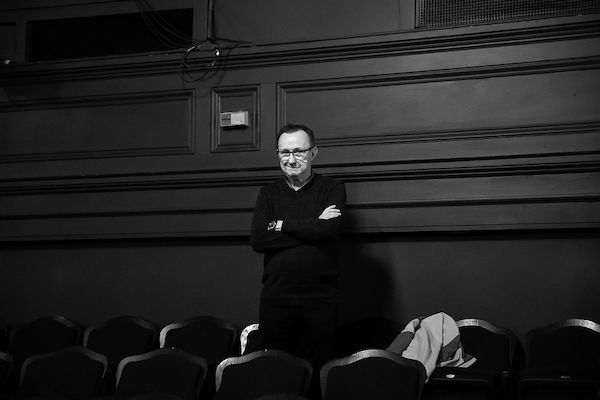
Fox served as assistant professor of theater instruction and director of theater at Ohio University Eastern for more than 35 years. During his tenure there, he staged more than 100 productions, directing, designing, and acting in many of them.
POWER COUPLE AT THE HELM
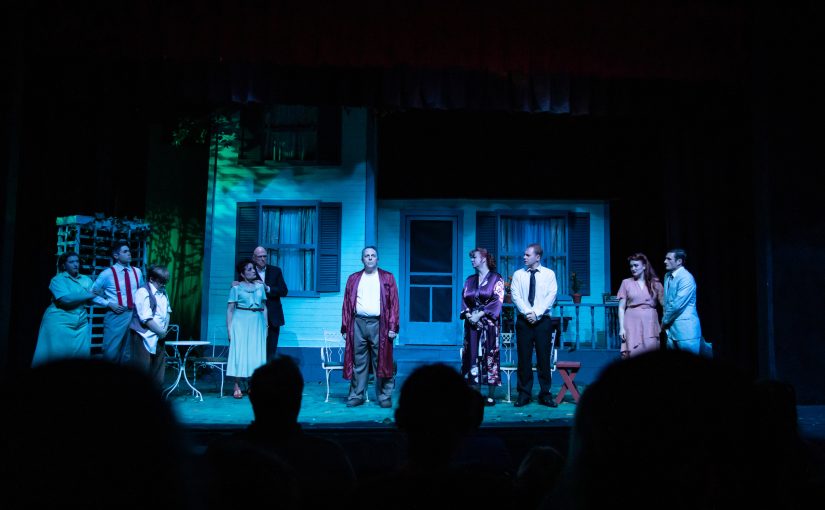
Last season’s knock-out presentation, “All My Sons,” is about a successful businessman, Joe Keller, who has been blinded by lust for money during World War II, which results in a tragic conflict between family loyalty and social responsibility.
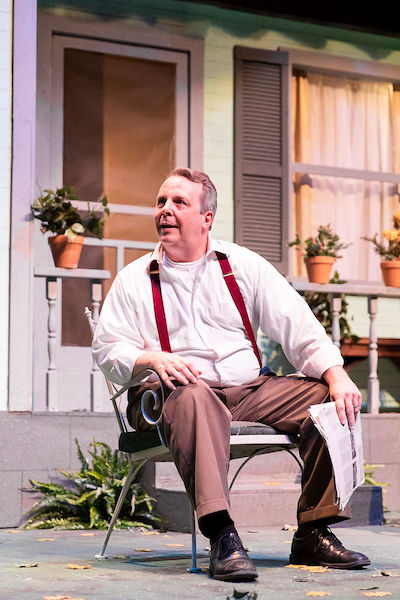
The cast was led by husband and wife Tim and Rachel Thompson as Joe and Kate Keller. Rachel also works at Oglebay Institute in customer service.
“Directing Tim and Rachel together was a joy,” Fox said. “They are both consummate professionals. I had directed Rachel twice at Ohio University Eastern, but I had never directed Tim before ‘All My Sons.’ The roles of Joe and Kate define the play. They are large, and they are physically and emotionally demanding. Neither Tim nor Rachel is like Joe or Kate, so that made each rehearsal a personal discovery. The fact that they are partners in real life gave them an extra level of trust to explore their characters, which both go to some very dark places onstage. They are both very open to ideas and suggestions, which made the rehearsal process exciting.
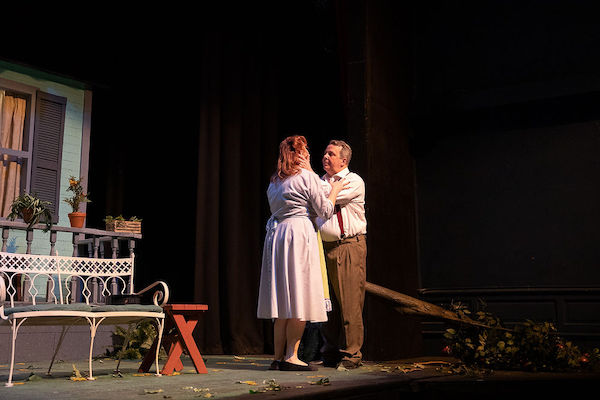
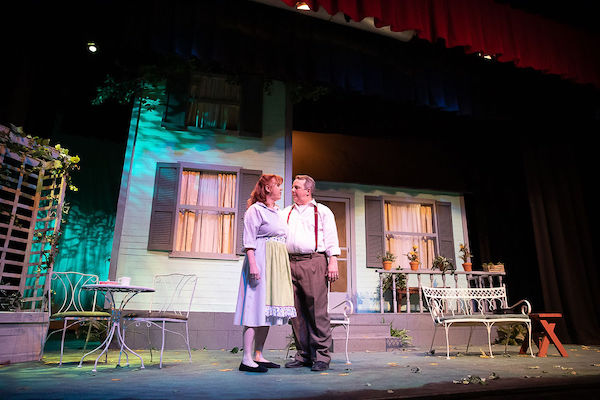
“Both Tim and Rachel set a great tone and example for the rest of the cast. In rehearsal, you would never have known they were husband and wife, but their chemistry was very evident in their portrayals. It’s the best work I’ve seen from either of them.”
While neither Tim nor Rachel could point to another married couple they’d like to play in the future, both loved working together.
“I just want to act with Rachel more,” Tim said. “She is terrific … so damn talented. And it is exciting, rewarding, and fun to be on stage with her. A very giving actor … but any role with her would be a pleasure.”
Rachel added, “I would love to play opposite Tim again. I think we make a great team.”
ASKED & ANSWERED
Tim and Rachel shared some thoughts about their experiences in “All My Sons.”
Q. What an emotional production! Were the two of you drained every time you rehearsed and performed? How did you decompress?
Tim: Yes, I was drained after every rehearsal and every performance. My character, Joe Keller, has spent the last several years keeping the truth hidden, and this is the day the truth is exposed. Embodying all the back story as well as the confrontations of the day the story takes place was enormous. Joe Keller was the most complex character I ever portrayed, and it took its toll on me. Not complaining, I loved it. But my mind and body were spent each night, especially after performances.
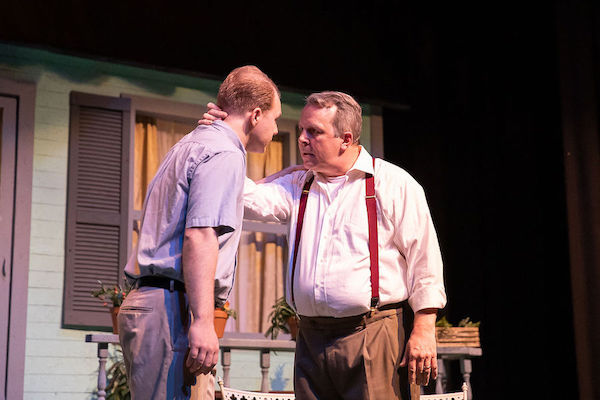
How did I decompress? … After rehearsals I always review notes, thoughts, lines missed from the evening. Rachel and I would often discuss what worked and what didn’t … or personal issues (that was quite an advantage for us), and then I would do anything I could to not think of the play…TV show, sports, and try to sleep, which was not always easy … anything that took my mind off of the play.
After performances, we would do a meet and greet with the audience (a difficult task while numb from the performance), and then Rachel and I would relish the evening but leave it at Towngate. It is important to leave the character at the theater after; it’s difficult but better mentally.
Rachel: Yes, I was definitely drained. It was a really emotional show for me. It was difficult in rehearsals because Dennis would want us to rehearse an act twice, and it was hard to bring the same intensity for both takes, especially act three, which took everything out of me. I would usually not go full throttle until the actual performances. Personally, I left it all on the stage, and I didn’t bring it home. When I did come home, I would try and relax and get my mind off of the play, usually by vegging out in front of the TV.
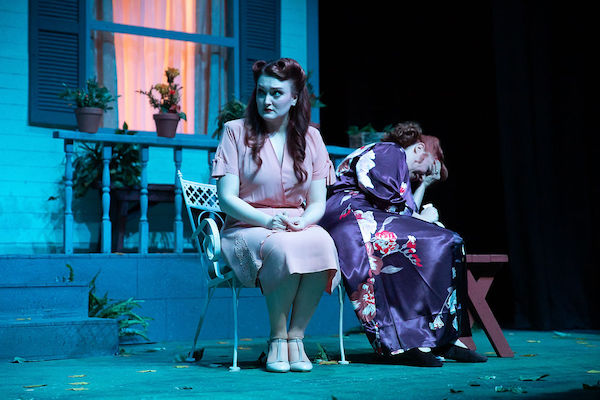
Q: You have been married for 13 years. What is it like to portray a husband and wife? Is this the first time you’ve been husband/wife in a play? How do you believe your real-life chemistry seeped into the play?
Tim: It is the first time we have played husband and wife. We did play old friends who plan to marry after her character became a widow and my character divorced in Paul Orr’s play “The Widows Tale.” It was a treat and dream come true to play husband/wife in “All My Sons.” The trust is already there, so doesn’t need to be established in rehearsals. Rachel is one of the most talented actors I have ever met, so to play any role with her is an exciting opportunity. But to play husband and wife is the cherry on top. I loved it.
I would have to say that the part of our real-life chemistry that seeped in was how comfortable we are with each other. The trust. To portray 30+ years of marriage with secrets and history together with an actor you don’t know well would take a great deal of preparation in rehearsals. We were able to begin rehearsals with already having that. That is a huge advantage.
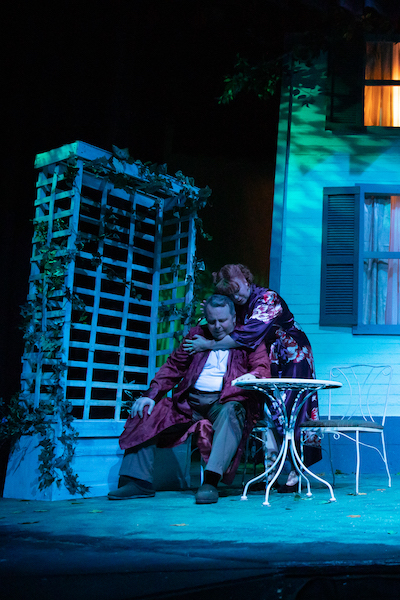
Rachel: We just celebrated our 13th anniversary, together for 20 years. The best part of playing husband and wife was the built-in chemistry and trust of each other. That’s really important to any actor. We did play opposite each other in one other play, “The Widow’s Tale,” written by our friend Paul Orr who just recently passed away. “All My Sons” was a little different because the characters we played were so unlike ourselves in real life, or at least for me, but there was never a time on stage where I looked at Tim and saw Tim. I always saw Joe.
Q: What’s the hardest part of sharing leading roles in a play? The best part?
Tim: I really can’t think of anything that was hard about sharing lead roles. I loved it. Rachel is an amazingly talented actor, my best friend, and love of my life. I can say this, I sometimes found myself admiring her work so much I lost my train of thought for Joe. The best part was just sharing the stage with her and nailing it alongside her. The satisfaction we share with this production is beyond compare.
Rachel: I think the hardest thing was that both of us had to be at rehearsals for long periods of time, leaving our daughter, Grace to fend for herself. The best part was being up on that stage sharing something we both love with each other.
Q: Did the play come home with you? Did you talk/rehearse/think about it together at home?
Tim: The process came home with us, but not the tension Joe and Kate experience. We would discuss the play, the production, the relationships but never allowed our real life affected. One thing about rehearsing at home, Rachel and I work differently. I never run lines with anyone. I learn on my own. Rachel likes to run them. I gave in a few times as we got closer to opening. Mainly because I kept blowing the same lines in a scene with her. It worked. I felt our scenes were tight.
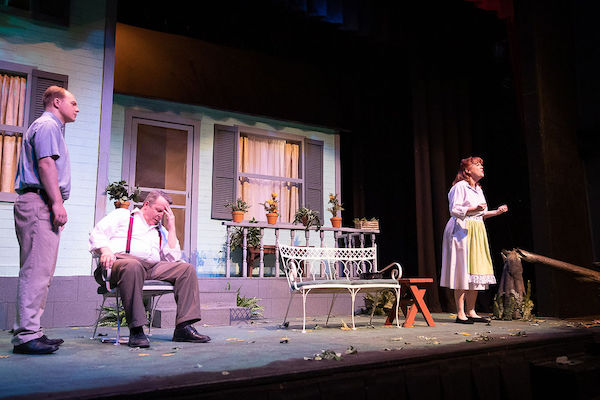
Q: The fact that the play involves the death of a child, and the two of you have a daughter, was that piece of the action particularly devastating?
Rachel: It was devastating for me because I had to truthfully portray the anguish of a mother who has learned of her child’s death. I didn’t think of Grace specifically, just tapped into that emotion. It destroyed me every performance because I had to take myself to that place to give an honest and believable performance. People would ask how I could make myself cry every night. I couldn’t NOT cry. I felt every bit of Kate’s pain.
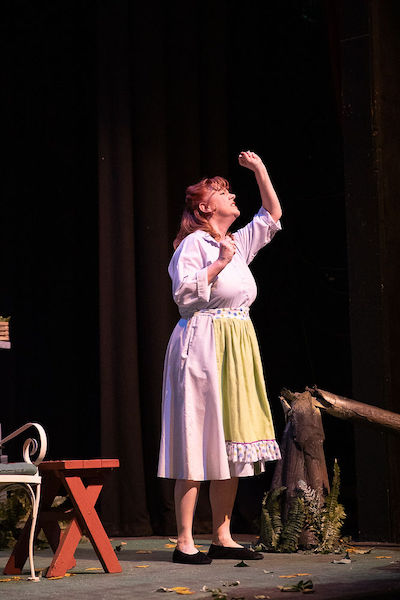
Q: I’d love it if you both could talk a bit about the play itself … Who was Kate? Who was Joe? What did you learn from them?
Rachel: Kate is a strong, no-nonsense woman who will fiercely protect her family. I suspect she is the real head of the household. She is hopeful and capable of immense love. She’s also a little unstable and can lash out if need be. What I took away from Kate was her strength. She gave me confidence.
Tim: Joe is a self-made man. Had a very rough childhood … on his own at 10. Worked his way up to running a shop, getting married, having a family, and then owning a factory. So, it was ALL about family. His sons and his wife. Period. That’s what you hope for in the “American Dream” — for your children to do better than you. Wanted his wife to have an easy life and his sons a successful and profitable future …then he made a very bad choice. I learned always best to be honest and accountable for your actions. If Joe was, this could’ve turned out differently … better. Another lesson … one bad choice can ruin everything in your life.
Q: Some of the words used to describe the performance/production were “gut wrenching,” “memorable,” “engaging,” and “riveting.” Can you comment on why you think the play got rave reviews? What words would you use to describe the production?
Rachel: Two reasons why the show got the attention it did was the material and the talent. If you have a great script and strong actors, you will have memorable show. I would describe the show as gut wrenching, thought provoking, and intriguing.
Tim: The play was a success and got rave reviews because of our teamwork … our director, designer, cast worked diligently to find the truth in Arthur Miller’s great play. The success came from total effort, passion, and commitment from all involved during the rehearsal process.
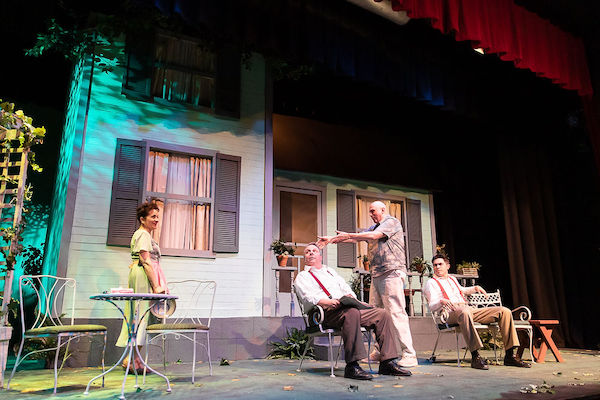
The production was also a hit thanks to our director, Dennis Fox. He cast it well. Understood the play impeccably. He knows how to treat actors and is constantly seeking nuances about the play. His passion for theater is contagious. He created a trusting and exciting atmosphere for all of us to work and play.
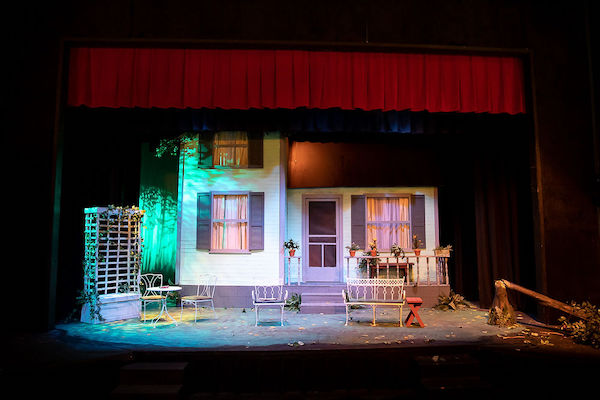
Also, Dave Henderson gave us an incredible set … and P.D. Gregg did lighting and sound. When doing a play like this, the environment is so important, and Dennis and Dave wanted it as realistic as possible and close to the audience. So, people felt they were in the backyard with us. I think that worked beautifully.
IT’S ABOUT COMMUNITY
“Last season was a success, but our main season still has room to grow,” said Tim.
“We invite those interested in being part of the creative process of a play to come audition or call to help with production. And that includes AUDIENCE.”
“Theater is an exciting, immediate way to be engaged with a story. Come out and support our very talented local actors, directors, crew in these excellent plays. It is community theater … so be part of the community and attend. You will not be disappointed,” he added.
There is much to experience, much to gain from joining a production at Towngate — in any role — as actor, director, crew, or audience member.
“It is one of the best feelings in the world when you are acting, and you move people; get them to feel, to laugh, to cry, to think … to become engaged in a story that is happening right now … in the moment … immediate.”
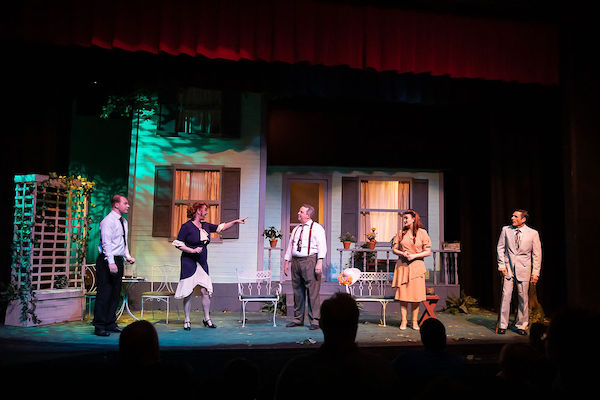
“… if I never act again, I can retire satisfied because of ‘All My Sons.’ Everything about it made it the best experience I have ever had acting. The best being Rachel … but Dennis, the role, and the cast made it special, too. And, of course, our audience that found it ‘riveting,’ ‘engaging,’ ‘gut-wrenching,’ and ‘memorable.’ How can it get any better than this?”