Blog

Oglebay Institute Announces Capital Campaign

The non-profit arts and cultural organization Oglebay Institute hosted an event July 29 to announce the public phase of its $4.4 million Preserving Our Past; Creating Your Future capital campaign to address critical priorities throughout the Institute. The announcement, which coincided with the organization’s 91st anniversary, took place at the Stifel Fine Arts Center in Wheeling—one of the Institute’s historic buildings that will be renovated as a result of the campaign.

Oglebay Institute Capital Campaign Projects

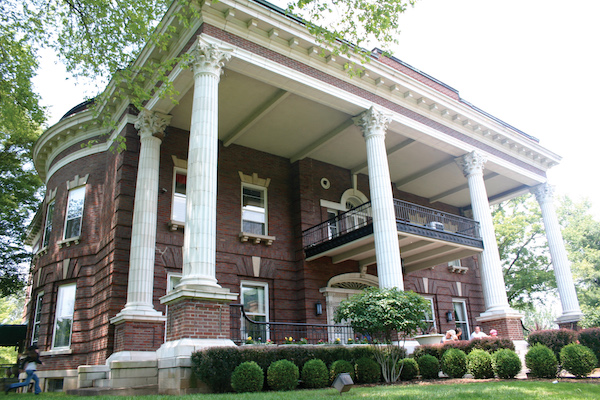
$1.6 million of the funds raised will go toward roof removal and replacement, masonry work, rehabilitation of the front porch columns and other restoration priorities on the 110-year-old Stifel Center. Other projects that will be addressed include roof replacement and structural preservation at Towngate Theatre, exhibit development and audience engagement projects across the Institute and endowment growth.

“Donations to this campaign are an investment in Oglebay Institute’s ability to meet both the current and long-term needs of our community,” Oglebay Institute president Danielle Cross McCracken said.

According to McCracken, campaign priorities were determined through extensive research, discussion and strategic planning throughout the past five years. The most critical restoration projects were identified through a historic structures report, conducted by McKinley and Associates Architecture and made possible through a grant from the WV State Historic Preservation Office in partnership with the Wheeling Historic Landmarks Commission.

Stifel Center is a Monument to Wheeling History and a Place to Create & Connect

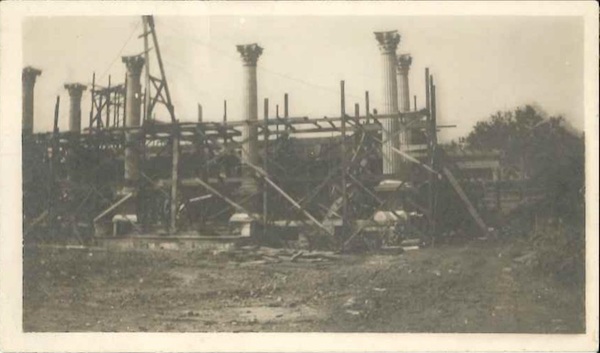
Constructed in 1912 and originally the Stifel family home, the building was donated to Oglebay Institute in 1976 for use as a public arts center. “Built of steel-reinforced concrete, it was designed to stand the test of time. However, despite routine care and maintenance, roofs have life-spans and replacement is now critical to prevent additional and even more costly damage,” McCracken explained.

Mr. Stifel required that the building be fireproof, so steel, brick, concrete and block were used throughout. All the floors, including the attic floor, are poured concrete; interior walls, some eight inches thick, are concrete. The structural system to support this massive structure is concrete enclosed steel I-beams supported by piers and bearing walls. This unique construction makes the Stifel Fine Arts Center distinctive because in 1910, when the home was being built, such construction techniques would have been limited to skyscrapers and large commercial buildings, not a single family’s private residence.


An iconic focal point of the Dimmeydale neighborhood, the Stifel Fine Arts Center welcomes 13,000 people annually to its classrooms, galleries and picturesque grounds. Stifel Center director Rick Morgan said it serves as “a bridge between the visual arts and the community.”

“On any given day, you can see people connecting to art in a variety of different ways. You can walk into our classrooms and studios and hear artists of all ages and backgrounds sharing techniques and encouraging each other. When you walk through the gallery, you might see someone quietly looking at the art or friends discussing what they think about a particular piece. On the weekends, people fill the building to hear live music and enjoy social events surrounded by artwork. It truly is a community gathering place,” he said.

Upon the death of Mrs. Edward W. Stifel Sr. in 1976 at the age of 97, her children and their descendants deeded Edemar and the surrounding property to Oglebay Institute for use as a public arts center. An iconic focal point of the Dimmeydale neighborhood, the Stifel Fine Arts Center now welcomes 13,000 people annually to its classrooms, galleries and picturesque grounds.


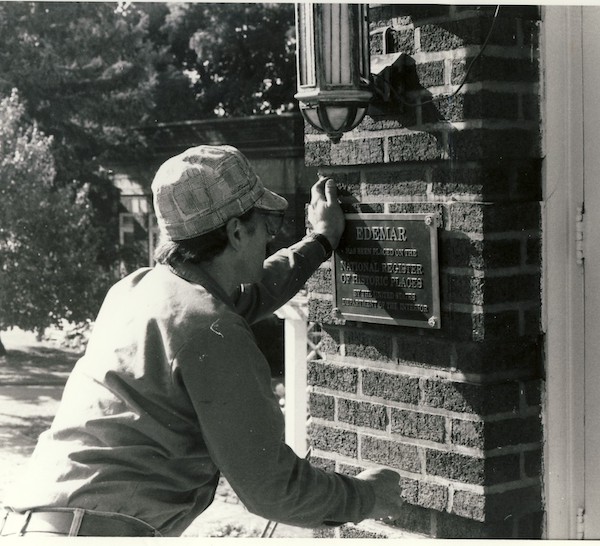
The Stifel Fine Arts Center is listed on the National Register of Historic Places. Morgan said it’s fitting that it is home to a public arts center because the building itself is “a work of art and a really cool visual symbol of how much our community values arts, culture and history.”

Started in 1910, the construction of this Neoclassical Revival Style mansion of Edward W. Stifel Sr., grandson of J.L. Stifel and a company executive, and his wife Emily Pollock Stifel took two years to complete. It was named Edemar for their three children, Edward, Emily and Mary. The building is listed on the National Register of Historic Places.

Restoration Work

Work on the Stifel Fine Arts Center will begin this summer and is expected to be completed by December. No interruption of programming is anticipated.

McCracken said completing restoration work on a historic building of this size is a “complex and very costly process;” thus, the need to raise funds.

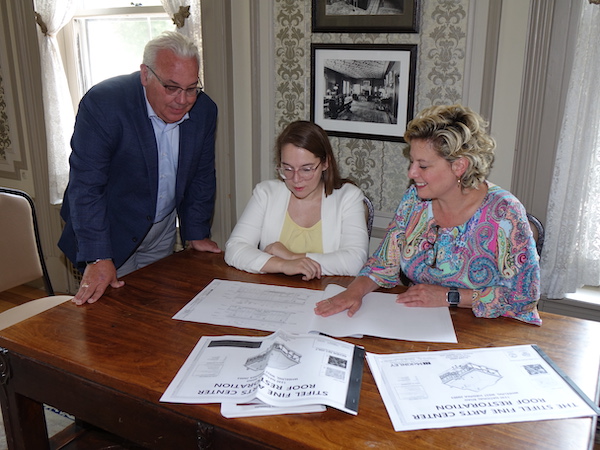
John Culler, chairman, Oglebay Institute Board of Trustees, Micah Underwood, Oglebay Institute development director and Danielle Cross McCracken, Oglebay Institute president, review plans for the roof restoration project for the Stifel Fine Arts Center, which is set to begin this summer.


“The roof is one of the most important features of an historic building, both functionally, to protect the contents within, and visually, to maintain the architectural and historic integrity of the landmark,” she said. “While Oglebay Institute has been a wonderful steward of this property for more than four decades, a project of this magnitude requires specific materials and highly specialized labor. And because of the meticulous nature of the work, it is very time intensive. All of those factors result in an expensive, but very important, process that the organization simply can’t cover within the confines of our regular non-profit operating budget.”

Lead Donors

Launched in 2019, the campaign has raised more than one million dollars. More than 100 community donors, local businesses and area foundations have supported the campaign.

Lead donors include Emily Hart Burchfield, the James B. Chambers Memorial Foundation, Gary & Missy Glessner, Anne Stifel Honer, Chris & Cheryl Riley, the Schenk Charitable Trust, WesBanco Bank, Inc. and the WV Department of Arts, Culture & History.

Support the Campaign

Now, the nonprofit is asking the public to join the fundraising effort, which is expected to conclude by the end of 2021.

“Community investment created and sustains Oglebay Institute,” said development director Micah Underwood. “Gifts to the campaign, no matter the size, help preserve our buildings, expand opportunities for imagination and develop our financial resources now and for the future.”

To learn more about the Oglebay Institute capital campaign and ways to give, contact the Oglebay Institute development team at 304-242-4200 or visit www.oionline.com/capitalcampaign.

This program is presented with financial assistance from the WV Department of Arts, Culture and History, and the National Endowment for the Arts, with approval from the WV Commission on the Arts.

About Oglebay Institute:

Established in 1930 by community volunteers, Oglebay Institute was formed to “contribute to the joy of living” through arts, nature and cultural experiences.

The Institute operates six venues in Wheeling—The Stifel Fine Arts Center, School of Dance, Towngate Theatre, Mansion Museum, Glass Museum and Schrader Environmental Education Center. Collectively, the hundreds of programs produced each year through the Institute provide education, entertainment and enrichment experiences to more than 70,000 people annually.


Theater Returns to Towngate this Weekend with “Future, Here”

This weekend, Oglebay Institute’s Towngate Theatre opens its 52nd season with “Future, Here,” an original play by Wheeling native Jeremy F. Richter and directed by PD Gregg.

Set in Future, a village run by Society, “Future, Here” follows the final meeting of five children who have grown up as members of an institutional initiative to produce “appropriately adapted young citizens.”

Their only connection to the outside world has been through a smartphone given to them upon their arrival 12 years ago, and their only human connection has been with each other, once a day in the evening for a limited time. Now that they’re 18, each will be relocated to a new residence, but none of them know where.

The production features a wealth of youthful talent: Mecca Collins, Stephanie Ebarb, David Gaudio, Clare Seibert and Dailey Ward.

Existing in a Parallel Reality

“Future, Here” was originally scheduled to be staged back in July as part of the Parcel Players’ season. Unfortunately, the COVID-19 pandemic forced its cancellation. Although standards related to public gatherings have since been clarified, it is still a challenge to produce a live show.

“All performers must maintain social distancing or be masked,” Gregg said. “When it became clear that we would not be able to stage the play we had planned to do in September because of the COVID restrictions, “Future, Here” seemed like a perfect replacement.”

At first, PD and Jeremy thought the play would need to be revised in order to feel contemporary.

“But each time I went to work, it felt forced,” Jeremy said. “I’m fortunate that “Future, Here” is an easy show to produce in a variety of ways. Earlier this month, a company produced the show virtually and it translated really well. After seeing the virtual production and how well that environment fit into the world of the show, I couldn’t see masks posing any dramaturgical issues.”

PD describes Society and the village of Future as a “parallel reality.” If the audience will be wearing masks, why not the performers?

Relating to the Pandemic Experience

Although the play was written prior to the pandemic, the themes of isolation, social injustice, and impending doom are incredibly relevant today, PD said. “It should give the audience a lot to think about.”

Actor Mecca Collins feels a kinship with the worldview her character, Actor 1, possesses.

“She is blunt and has a lot of rage surrounding the topic of injustice in society,” Mecca said. “I relate to her because I, too, am fed up with all of the injustice in the world and feel almost helpless in the matter. Which is why, I think, my character and I are both upset.”

PD said the play calls for the actors to use their actual names in lieu of character names, which has perhaps added motivation to their portrayals. In fact, Mecca said she’s discovered a powerful truth throughout the rehearsal process.

“Simply being aware of the injustice in Society did nothing for my character. Action needs to take place in order for change to happen and I believe that will stick with me for the rest of my days.”

Jeremy said it’s always rewarding to hear how actors respond to their participation in “Future, Here.”

“I do hope they leave the process with a connection to and fulfillment from the script and role. I’m proud to say that I’ve met nearly half of the casts that have performed “Future, Here.” I’ve learned something from each of them, and hope that they’ve learned something about themselves, their communities, their politics and perspective as well.”

Bringing “Future, Here” Home

Tim Thompson, OI’s director of performing arts, is pleased to carry on founder Hal O’Leary’s mission of opening doors for artists of all backgrounds, including playwrights. He recalled how the recently departed Tom Stobart was Towngate’s “playwright in residence” during the 1980s.

“Towngate produced and Hal directed six of Tom’s plays in 12 years from 1980-1992. It was a magical time at Towngate,” Tim said. “Now we have Jeremy Richter. In 2014, we produced his adaptation of ‘A Christmas Carol,’ which broke attendance records. It’s the right time for ‘Future, Here.’ And I want to continue to produce his plays–as many as possible. Jeremy is a great playwright, just like Tom. He learned from Tom.”

Playwright Jeremy Richter

Although Jeremy has had more than a few large-scale opportunities throughout his career, he said he feels a great deal more comfort and familiarity with hometown productions of his work.

“They better facilitate risk-taking and collaboration,” he said. “While each of those major-city productions were special, they all carried an amount of pressure that inevitably took some of the joy out of the process: to sell tickets, to get a favorable response, to see a glimpse of my original intention that got me to write the script in the first place.”

Those feelings may still exist locally, but there’s less uncertainty because Jeremy knows the community and the community knows him.

“The process becomes more about a mutual journey and less about making or leaving an impression,” he said. “It’s more cathartic and in tune with the creation and communion of the arts. A writer’s dream may reach for the famed lights of Broadway, but the aspiration is to have a home that allows you to create and develop your craft alongside fellow artists.”

Will People Come to See the Play?

Ever since the pandemic struck, Tim said he has made an effort to postpone instead of cancel as many events and productions as possible. He and his staff are going above and beyond to ensure the theater is prepared for both the performers and audience.

“We have an excellent housekeeper, Dominique McAvoy, who is amazing at keeping us sanitized and safe,” Tim said. “We will monitor people who come in by taking temperatures and mandating masks. Our audience has been sectioned off for social distancing. We can have 50 in the audience with 166 seats.”

His only concern is one shared by performers and artists around the country: Will people come to see the play?

“I really hope so,” Tim said. “Everyone involved has been working very hard and director PD Gregg has assembled a very talented cast.”

“My thanks to OI, Tim, PD and the cast of Towngate’s ‘Future, Here,’” Jeremy added. “Buy a season ticket subscription and support your hometown artists!”

Get Tickets

You can see “Future, Here” at 8pm September 18, 19, 25 & 26 or 3pm September 20. Tickets are $12.50/$11 OI members/$6.25 students.  Purchase tickets online or call 304-242-7700.

The 2020-21 community theater season at Towngate is sponsored by Unified Bank.

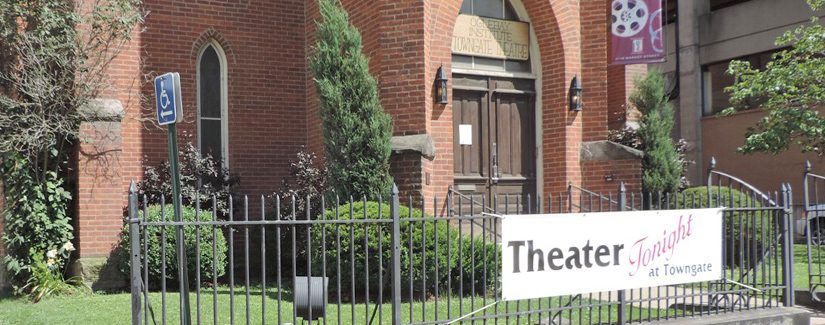
Oglebay Institute’s Towngate Theatre